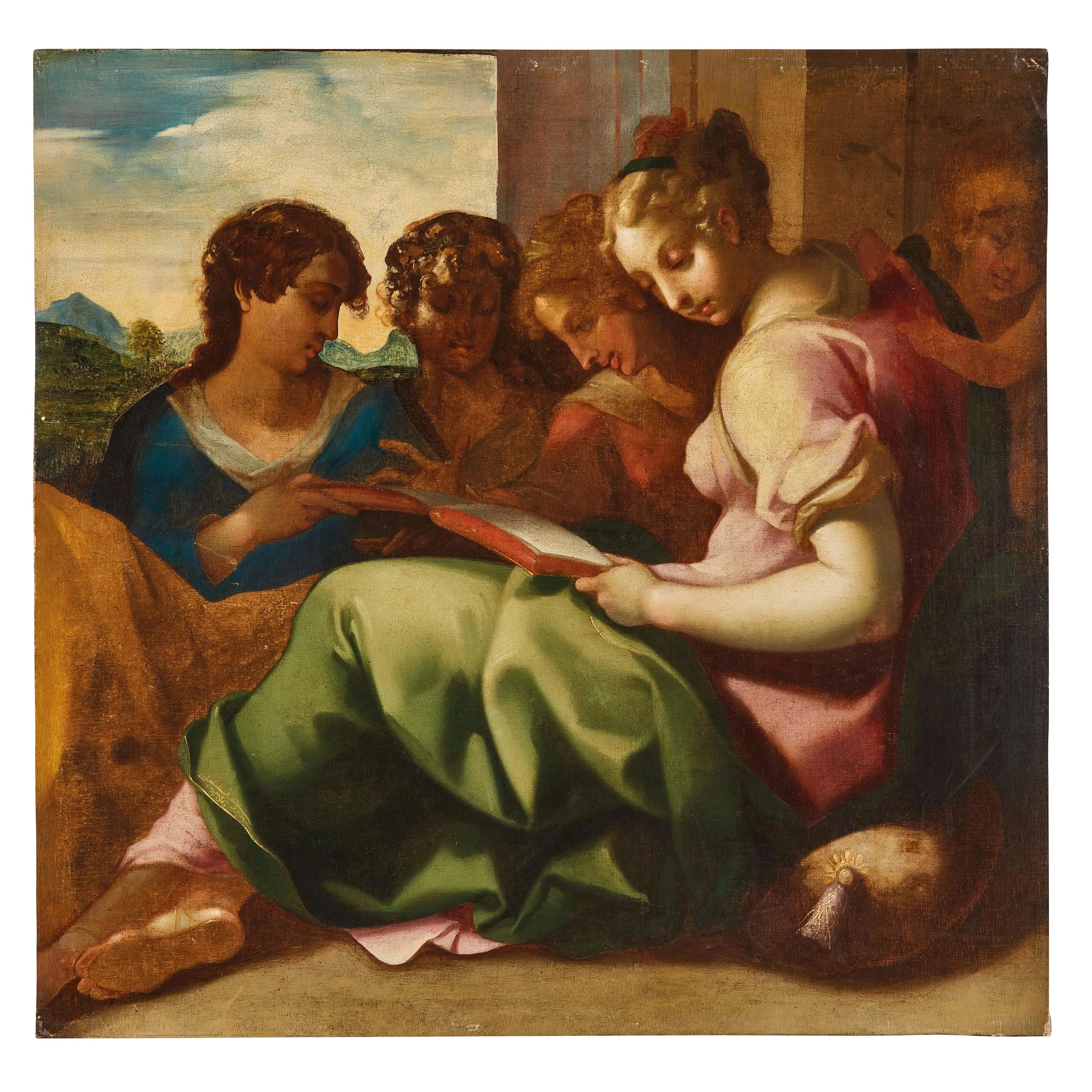

Emilian painter, 16th century
ALLEGORY OF PHILOSOPHY
oil on canvas, 97.5x100 cm
Pittore emiliano, sec. XVI
ALLEGORIA DELLA FILOSOFIA
olio su tela, cm 97,5x100
The work depicts a refined female allegory identifiable as Philosophy, rendered in a figurative style of classical origin rooted in the artistic culture of central Italy during the height of the sixteenth century. The figure, composed with monumental balance and characterized by a solid sculptural structure, reveals a formal exploration that transcends mere devotional or narrative elements to reach an intellectual dimension typical of humanist culture.
The anonymous artist appears to belong to the Emilian school and demonstrates a training open to the major figurative trends of his time. In the soft construction of the volumes and the carefully balanced blend of idealization and naturalism, one can discern significant points of contact with the style of Antonio Allegri, known as Correggio, from whom the artist appears to have absorbed the gentle modulation of light, the fluidity of the modeling, and the delicate atmospheric rendering of the pictorial surfaces. Although he does not achieve the more dynamic results of Correggio’s master, the painter assimilates his sensitivity to light and his taste for a measured and harmonious beauty.
The solid compositional structure and the nobility of the conception also seem to presuppose a direct familiarity with Roman culture of the early decades of the 16th century and, in particular, with Raphael’s innovations, whose influence is evident in the figure’s poise, in the composure of the gesture, and in the ideal of classical harmony that governs the entire composition. It is not unlikely that the artist had the opportunity to engage with Raphael’s models during a stay in Rome or through the circulation of cartoons and drawings from the Urbinate’s circle.
The color scheme, rich in saturated yet skillfully harmonized tones, as well as the strong sculptural presence, ultimately point to a sensibility akin to that of Daniele da Volterra, especially in the treatment of color.
The work thus stands as an interesting testament to the circulation of figurative models between Emilia and Rome in the mid-16th century, a period in which the Correggio school interacted with Raphael’s classicism and with developments in Central Italian Mannerist culture.