
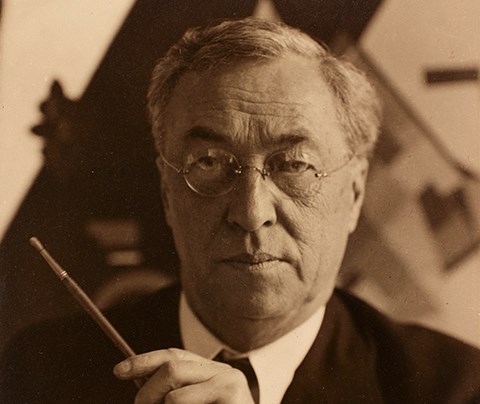
Evaluation Vassily Kandinsky
Vassily Kandinsky Valuations - Want to sell a Vassily Kandinsky piece? Request a complimentary and confidential valuation!Pandolfini Casa d'Aste will review your submission and offer a free-of-charge estimate, if your item is suitable for our auctions.
biography
Wassily Kandinsky was born on December 16, 1866, in Moscow to a well-to-do family of businessmen in a culturally rich environment. Between 1886 and 1892 he studied law and economics at Moscow State University, where he subsequently taught after graduation. In 1896, at the age of thirty, he declined a professorship at Dorpat University to dedicate himself entirely to painting, a decision that would transform his life and the history of modern art. He moved to Munich where he studied at painter Anton Ažbé's academy from 1897 to 1899 and subsequently in Franz von Stuck's studio in 1900.
Kandinsky became one of the pioneers of twentieth-century abstract art and a foundational theorist of the movement. In 1909 he was elected president of the Neue Künstlervereinigung München (NKVM), a newly founded group of artists. In 1911, together with Franz Marc, he began conceiving the publication of the Blaue Reiter (The Blue Rider), which would revolutionize European artistic thought. His first solo exhibition was held at the Der Sturm gallery in Berlin in 1912, and in 1913 one of his works was included in the Armory Show in New York and the first German Herbstsalon. During this period he developed his theories on spirituality in art and synesthesia between music and visual arts, publishing foundational theoretical works.
Between 1914 and 1921 Kandinsky lived in Russia, principally in Moscow, where he held a position at the People's Commissariat of Education. He was one of the founders of the Institute of Artistic Culture (INKhUK) in 1920 and taught at the State Art Laboratories and Vkhutemas from 1918 to 1921, developing an innovative curriculum based on the analysis of color and form. In 1922 he began teaching at the Bauhaus in Weimar, where he remained until the school's closure by the Nazis in 1933. In 1923 he had his first solo exhibition in New York organized by the Société Anonyme, of which he became vice-president. In 1924 he joined Lyonel Feininger, Alexei Jawlensky, and Paul Klee to form the Blaue Vier (Blue Four) group.
In 1925 he moved with the Bauhaus to Dessau and acquired German citizenship in 1928. With the rise of Nazism, in 1933 he settled in Neuilly-sur-Seine near Paris, where he acquired French citizenship in 1939. During the Nazi purge of "degenerate art" in 1937, fifty-seven of his works were confiscated. In his final years in France, Kandinsky created some of his most significant works, continuing to develop his abstract language. He died on December 13, 1944, in Neuilly-sur-Seine, leaving an indelible legacy as theorist and practitioner of modern abstraction, a central figure of European modernism, and a master who influenced generations of artists.
Kandinsky became one of the pioneers of twentieth-century abstract art and a foundational theorist of the movement. In 1909 he was elected president of the Neue Künstlervereinigung München (NKVM), a newly founded group of artists. In 1911, together with Franz Marc, he began conceiving the publication of the Blaue Reiter (The Blue Rider), which would revolutionize European artistic thought. His first solo exhibition was held at the Der Sturm gallery in Berlin in 1912, and in 1913 one of his works was included in the Armory Show in New York and the first German Herbstsalon. During this period he developed his theories on spirituality in art and synesthesia between music and visual arts, publishing foundational theoretical works.
Between 1914 and 1921 Kandinsky lived in Russia, principally in Moscow, where he held a position at the People's Commissariat of Education. He was one of the founders of the Institute of Artistic Culture (INKhUK) in 1920 and taught at the State Art Laboratories and Vkhutemas from 1918 to 1921, developing an innovative curriculum based on the analysis of color and form. In 1922 he began teaching at the Bauhaus in Weimar, where he remained until the school's closure by the Nazis in 1933. In 1923 he had his first solo exhibition in New York organized by the Société Anonyme, of which he became vice-president. In 1924 he joined Lyonel Feininger, Alexei Jawlensky, and Paul Klee to form the Blaue Vier (Blue Four) group.
In 1925 he moved with the Bauhaus to Dessau and acquired German citizenship in 1928. With the rise of Nazism, in 1933 he settled in Neuilly-sur-Seine near Paris, where he acquired French citizenship in 1939. During the Nazi purge of "degenerate art" in 1937, fifty-seven of his works were confiscated. In his final years in France, Kandinsky created some of his most significant works, continuing to develop his abstract language. He died on December 13, 1944, in Neuilly-sur-Seine, leaving an indelible legacy as theorist and practitioner of modern abstraction, a central figure of European modernism, and a master who influenced generations of artists.
Past lots of Vassily Kandinsky
Vassily Kandinsky
(Mosca, 1866 - Neully-sur-seine, 1944)
Vassilly Kandinsky
Vassilly Kandinsky
(Mosca 1866 - Neully-sur-Seine 1944)
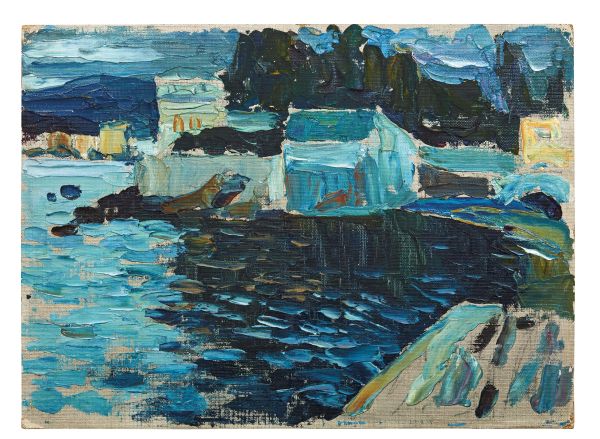
SESTRI-ABENDS
1905
olio [..]
Sold
Vassily Kandinsky
(Mosca, 1866 - Neully-sur-seine, 1944)
Vassilly Kandinsky
Vassilly Kandinsky
(Mosca 1866 - Neully-sur-Seine 1944)
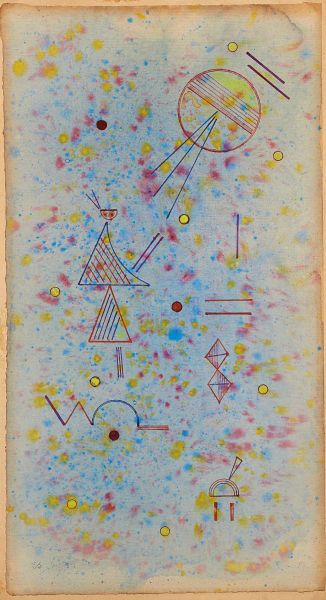
DÜNN UND FLECKIG SOUPLE
1931 [..]
Sold
VASSILY KANDINSKY
VASSILY KANDINSKY
(Mosca 1866 - Neully-sur-Seine 1944)
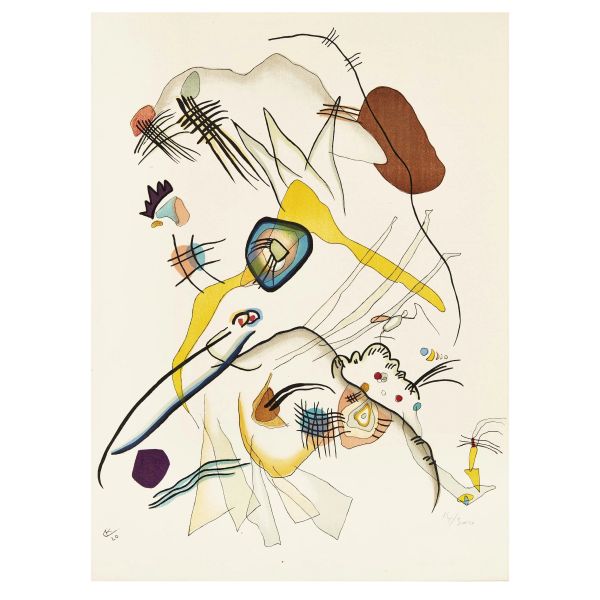
Promenade
1920
lithograph applied on cardboard [..]
Sold