
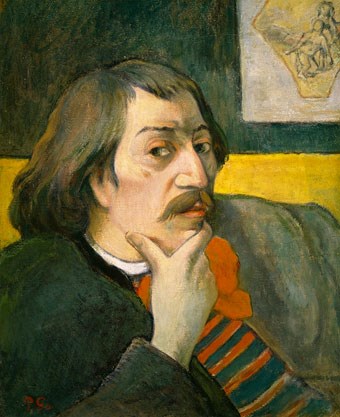
Evaluation Paul Gauguin
Paul Gauguin Valuations - Want to sell a Paul Gauguin piece? Request a complimentary and confidential valuation!Pandolfini Casa d'Aste will review your submission and offer a free-of-charge estimate, if your item is suitable for our auctions.
biography
Eugène Henri Paul Gauguin was born in Paris on June 7, 1848, to Clovis Gauguin, a journalist, and Aline Marie Chazal, daughter of the renowned South American writer Flora Tristán. His family had Peruvian roots; at the age of one he moved to Lima, Peru, where he remained until 1855, when he returned to France. After studying in Orléans and Paris, in 1865 he embarked as a cadet on a merchant ship to South America, sailing for several years and participating in the Franco-Prussian War of 1870. Upon returning to Paris in 1871, he began a brilliant career as a stock exchange agent with the Bertin company, an operation that secured him considerable financial comfort. In 1873 he married the Danish Mette Sophie Gad, with whom he had five children. During this period he met Pissarro and Cézanne, joining the Impressionist group and participating in several movement exhibitions. In 1883 he abandoned his work as a stock exchange agent and moved to Rouen to stay with Pissarro, dedicating himself entirely to painting. An artistic maturation led him to consider primitive artistic experiences as fundamental, prompting him to undertake a series of moves from Europe to South America to the French territories of the Marquesas Islands. In 1891 he moved to Tahiti seeking a remote, essential, and untouched environment, where he produced some of his most celebrated works, characterized by vivid colors and distinctly exotic themes. Among his most important works are Female Nude Sewing (1880), Vision After the Sermon (1888), Manao Tupapau (1892), Areaarea (1892), and Where Do We Come From? What Are We? Where Are We Going? (1897-1898). Life in Polynesia was not, however, idyllic: Gauguin faced illness, a suicide attempt in 1898, and, after moving to the Marquesas Islands in 1901, a period of detention for inciting indigenous people to rebellion. He died of syphilis in Hiva Oa on May 8, 1903, at the age of 56. His artistic experience, characterized by boldness in the use of color and experimentation with new visual and symbolic languages, was fundamental for his contemporary Nabis and profoundly influenced the research of the Fauves and German Expressionists of the Brücke group, consolidating his position as an iconic figure in the history of modern art.
Past lots of Paul Gauguin
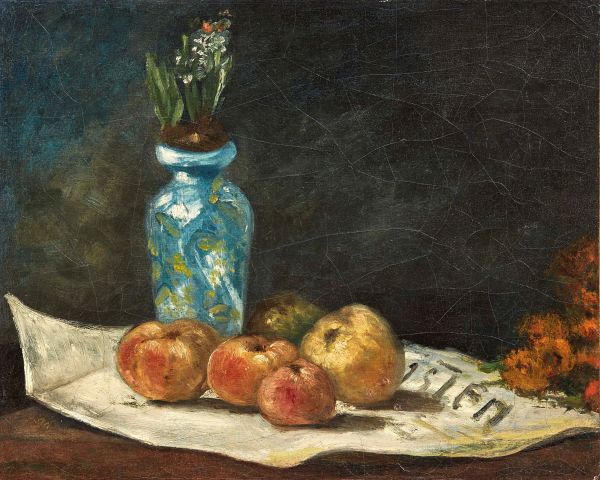
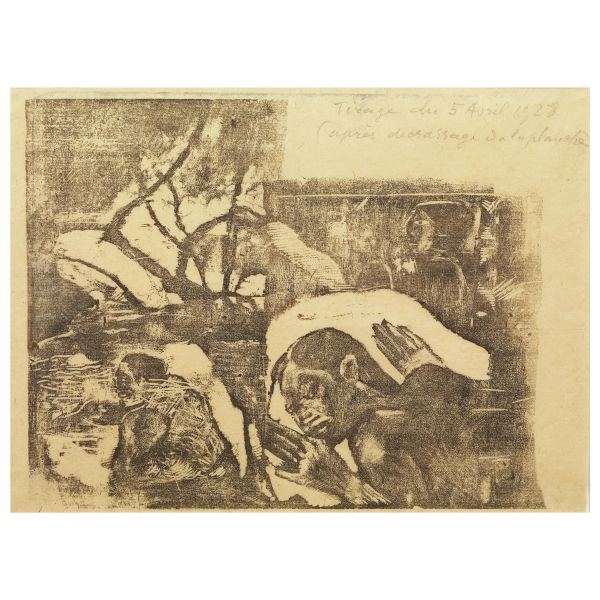
Paul Gauguin
Paul Gauguin
(Paris 1848 - Hiva Oa 1903)
JACINTHES ET POMMES SUR UN JOURNAL
1876 circa [..]
Sold
Paul Gauguin
Paul Gauguin
(Parigi 1848 - Fatu Iwa 1903)
a MANAO TUPAPAU (ELLE PENSE AU REVENANT)
b MAORIE WOMAN [..]