
Evaluation Edgar Degas
Edgar Degas Valuations - Want to sell a Edgar Degas piece? Request a complimentary and confidential valuation!Pandolfini Casa d'Aste will review your submission and offer a free-of-charge estimate, if your item is suitable for our auctions.
biography
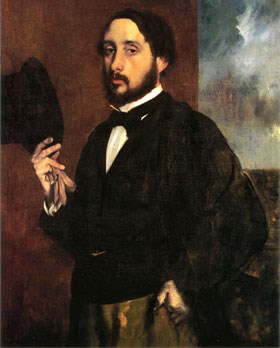
Hilaire-Germain Edgar Degas was born in Paris on July 19, 1834, into an aristocratic and wealthy family. His father, Laurent-Pierre-Auguste Degas, was a bank director of Italian origin, while his mother, Célestine Musson, was a French Creole from New Orleans who died when Edgar was only thirteen years old. The eldest of five siblings, Degas grew up in a culturally refined environment where he received a demanding and high-level artistic education. After completing his classical studies at the prestigious Lycée Louis-le-Grande in Paris, he briefly enrolled in the law faculty at the Sorbonne in 1853, following his father's wish to see him become a magistrate. However, his true passion was art, and after only six months he abandoned his legal studies to dedicate himself entirely to painting.
In 1854 Degas became a student of painter Louis Lamothe, himself a disciple of Jean-Auguste-Dominique Ingres, the master of French neoclassicism whose work would profoundly influence his style. In 1855 he successfully entered the École des Beaux-Arts in Paris, one of France's most prestigious academies of fine arts. During this academic training, Degas developed great admiration for ancient Italian masters and contemporary French art, particularly for Eugène Delacroix and Ingres. However, he soon felt suffocated by the sterility of academic drawing, which he considered inadequate and demoralizing, and abandoned the academy to train himself as an autodidact, drawing reliefs and works by ancient masters in Parisian museums.
In 1859 Degas returned to Paris and began creating historical paintings characterized by a fusion of studies on Italian masters and a naturalistic style. His decisive encounter with Édouard Manet in 1862 marked a significant evolution in his approach to painting. Degas dedicated himself to experimenting with artificial light, and many of his works depict the world of spectacle, ballet, and the interiors of Parisian gathering places. Although his works are often associated with Impressionism, Degas distinguishes himself through his masterful use of line and innovative pictorial compositions. His preferred subjects included portraits, ballerinas, horses, jockeys, Parisian nightlife, and women engaged in personal care. He painted with pastel and oil colors, also employing other graphic techniques with extraordinary mastery.
In 1870, during the Franco-Prussian War, Degas enlisted in an infantry regiment under the command of his old schoolmate Henri Rouart. During military service he was diagnosed with a vision defect, specifically in his right eye, and was transferred to artillery. This moment marked the beginning of the visual problems that would progressively lead to blindness. In 1880, upon returning from a trip to Spain, when he was already admired and respected in artistic circles, he began dedicating himself to engraving, exhibiting his works at an Impressionist exhibition in 1881. The death of his friend Manet plunged him into deep depression, leading him to isolate himself and discontinue public exhibitions, continuing to sell his works only through dealers.
Degas's final years were extremely difficult. Due to progressive vision deterioration, in 1908 he created his last pastels and drawings, dedicating himself exclusively to clay sculpture, the only activity possible for a blind person with the means available at that time. Beyond being a great painter and sculptor, Degas was also an important art expert and connoisseur. He spent his last years almost completely blind and isolated with a niece. He died in Paris on September 27, 1917, from a cerebral hemorrhage, leaving an extraordinary artistic legacy that established him as one of the most important French painters of the second half of the nineteenth century and an undisputed master of the representation of movement and light.
In 1854 Degas became a student of painter Louis Lamothe, himself a disciple of Jean-Auguste-Dominique Ingres, the master of French neoclassicism whose work would profoundly influence his style. In 1855 he successfully entered the École des Beaux-Arts in Paris, one of France's most prestigious academies of fine arts. During this academic training, Degas developed great admiration for ancient Italian masters and contemporary French art, particularly for Eugène Delacroix and Ingres. However, he soon felt suffocated by the sterility of academic drawing, which he considered inadequate and demoralizing, and abandoned the academy to train himself as an autodidact, drawing reliefs and works by ancient masters in Parisian museums.
In 1859 Degas returned to Paris and began creating historical paintings characterized by a fusion of studies on Italian masters and a naturalistic style. His decisive encounter with Édouard Manet in 1862 marked a significant evolution in his approach to painting. Degas dedicated himself to experimenting with artificial light, and many of his works depict the world of spectacle, ballet, and the interiors of Parisian gathering places. Although his works are often associated with Impressionism, Degas distinguishes himself through his masterful use of line and innovative pictorial compositions. His preferred subjects included portraits, ballerinas, horses, jockeys, Parisian nightlife, and women engaged in personal care. He painted with pastel and oil colors, also employing other graphic techniques with extraordinary mastery.
In 1870, during the Franco-Prussian War, Degas enlisted in an infantry regiment under the command of his old schoolmate Henri Rouart. During military service he was diagnosed with a vision defect, specifically in his right eye, and was transferred to artillery. This moment marked the beginning of the visual problems that would progressively lead to blindness. In 1880, upon returning from a trip to Spain, when he was already admired and respected in artistic circles, he began dedicating himself to engraving, exhibiting his works at an Impressionist exhibition in 1881. The death of his friend Manet plunged him into deep depression, leading him to isolate himself and discontinue public exhibitions, continuing to sell his works only through dealers.
Degas's final years were extremely difficult. Due to progressive vision deterioration, in 1908 he created his last pastels and drawings, dedicating himself exclusively to clay sculpture, the only activity possible for a blind person with the means available at that time. Beyond being a great painter and sculptor, Degas was also an important art expert and connoisseur. He spent his last years almost completely blind and isolated with a niece. He died in Paris on September 27, 1917, from a cerebral hemorrhage, leaving an extraordinary artistic legacy that established him as one of the most important French painters of the second half of the nineteenth century and an undisputed master of the representation of movement and light.
Past lots of Edgar Degas
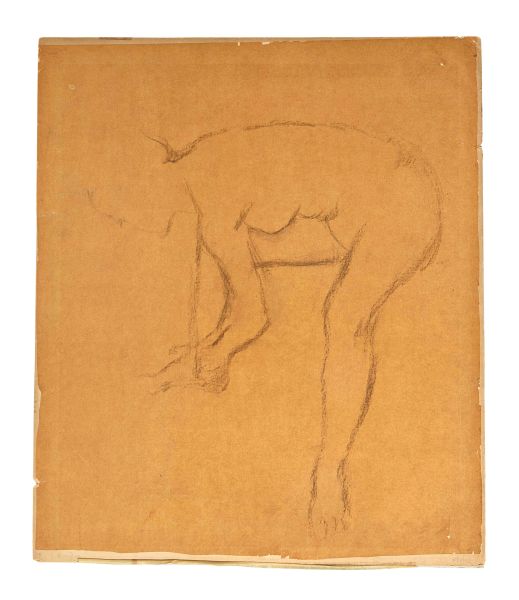
Edgar Degas
Edgar Degas
(Paris 1834 - 1917)
FEMME S’ESSUYANT LE PIED
1880 circa
pastello [..]
Sold