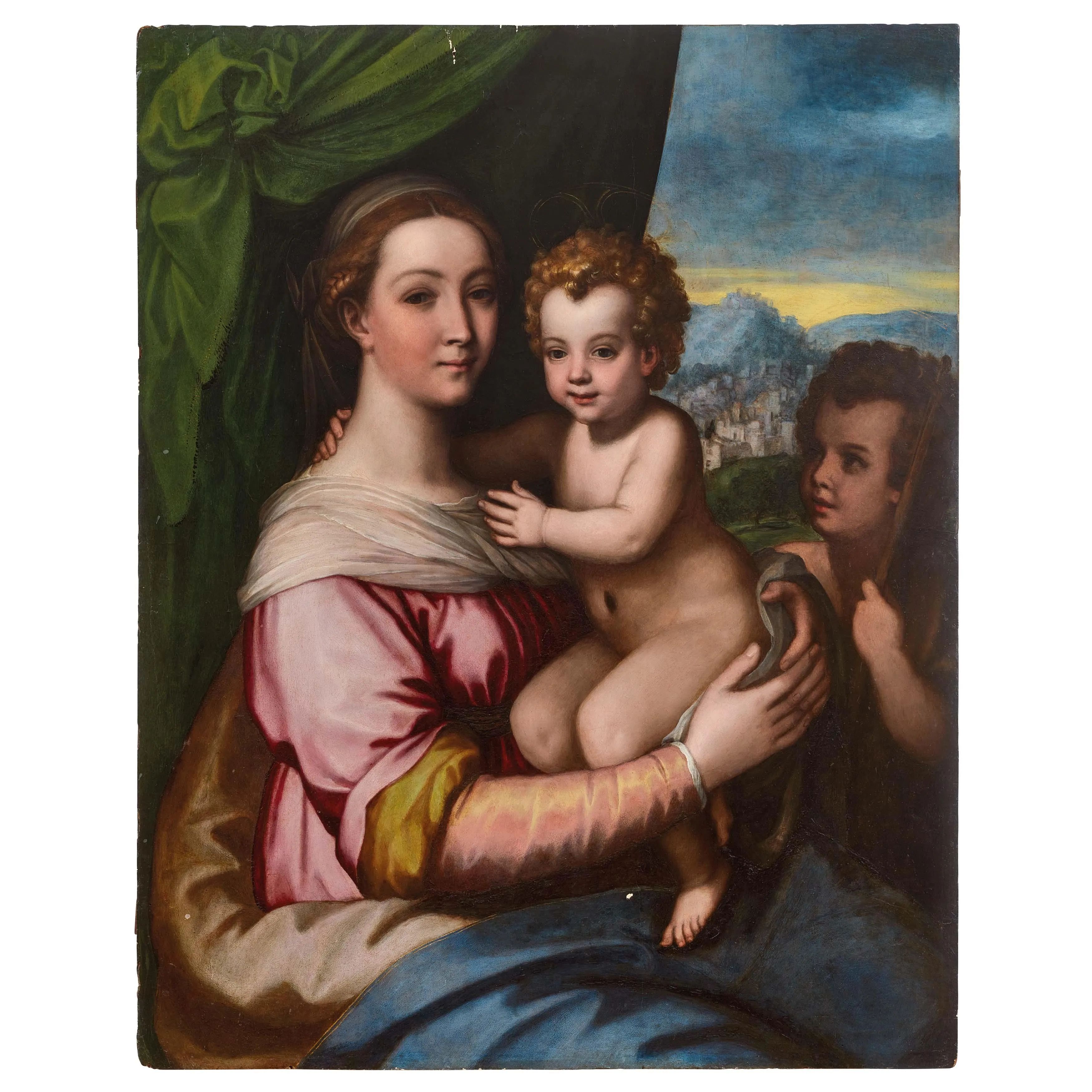

Emilian painter, 16th century
MADONNA AND CHILD WITH THE YOUNG SAINT JOHN THE BAPTISTE
oil on panel, 99x77.5 cm, unframed
Pittore emiliano, sec. XVI
MADONNA CON BAMBINO E SAN GIOVANNINO
olio su tavola, cm 99x77,5, senza cornice
The early decades of the sixteenth century represented a period of great artistic vitality for Emilia, characterized by the convergence of the artistic traditions of the mature Renaissance with local figurative traditions. Among the most significant influences was undoubtedly that of Raphael, whose artistic language contributed to the spread of a style of painting marked by compositional clarity, harmonious proportions, and the monumental quality of the figures. At the same time, Venetian painting fostered a growing focus on lighting effects and soft color modulation - elements that would go on to exert a profound influence on Emilian artists as well.
The painting presented here effectively reflects these characteristics. The composition, centered on the Madonna and Child with the infant Saint John, is distinguished by the balance of its pyramidal structure and the serene intensity of the exchange of glances. The light, coming from the upper left corner and suggested by the opening in the heavy green curtain, delicately shapes the skin tones of the Virgin and the Child, lending the figures a solid three-dimensional presence. Further back and immersed in a soft twilight appears the figure of the Young Saint John, depicted in an attitude of devout contemplation. In the background lies a vast hilly landscape with a hilltop village, rendered in atmospheric tones that expand the composition’s spatial depth.
From a stylistic perspective, the panel reveals a figurative tradition fully in step with the models of central and northern Italy. The delicate idealization of the Virgin’s face - characterized by an elongated oval, a slender neck, and a composed expression - echoes the elegant styles prevalent in the Emilia region during the second quarter of the 16th century, while the soft rendering of the skin tones and the refined treatment of the garments denote a chromatic sensibility that looks to Venetian painting. The work as a whole conveys an image of great formal balance, in which the composure of Raphaelite origin blends with a more modern pursuit of naturalistic light and atmosphere.